
Quarterly report · Pursat Province, Cambodia
CLIP2 quarterly report: July to September 2023
The seventh and final workshop, the end-line survey of teachers and the growing online reach of our Pursat preschool project, July–September 2023.
- 518preschool children in 10 target schools
- 1,804members of the Telegram channel
- 364,214views of all our YouTube videos
- 17,425visits to the Digital Library website
Project Overview
There are 3 main objectives of this project:
- To create/prepare/distribute teacher resources for preschool teachers.
- To install technical equipment (AccessBoxes) in schools to store teacher resources for preschools; and
- To train teachers on the use of the Access Boxes as well as how to upload and download resources.
There are two main beneficiary types:
- The preschool teachers; and
- The preschool students.
Background: This project will take place in the Pursat Province of Cambodia. It will provide Early Childhood Education (preschool) support to rural schools in the Pursat area. Cambodia is still catching up after the total dissemination of its education system during the Civil War (Khmer Rouge). Recently the government has legislated that Early Childhood Education (preschool) be compulsory. There are not enough resources for teachers and many are struggling with what to do with so many children in their classrooms.
Rermork for Children (in conjunction with TukTuk Charity) has been creating resources for preschools and has been successful at delivering resources via their digital library, which is available on the internet, and the "Access Box" (computer device that acts as a Wi-Fi, so teachers download resources without being connected to the internet) and training teachers how to access, upload and download resources.
Participants
Provincial Office of Education (POE)
5 officers
- Director
- Department of early childhood education
- Department of primary education
- Department of education audit
- Department of plan
District Office of Education (DOE)
8 officers (the director and the director of dept. early childhood education of each district)
- Pursat city
- Kandieng district
- Bakan district
- Krakor district
Target Schools
10 principals and 14 preschool teachers (2 principals are counted as preschool teachers too)
| No. | District | School Name | No. of Target Teachers (Number of Females) | Number of Class | Age group | Number of Students (Number of girls) | Remarks |
|---|---|---|---|---|---|---|---|
| 1 | Pursat | State school | 2 (2) | 2 | 3 years old | 30 (13) | Independent school*1 |
| 5 years old | 25 (8) | ||||||
| 2 | Prey Ny school | 1 (1) | 1 | 3 years old | 9 (3) | ||
| 4 years old | 19 (6) | ||||||
| 5 years old | 20 (10) | ||||||
| 3 | Lolok So school | 1 (1) | 1 | 5 years old | 33 (23) | ||
| 6 years old | 1 (0) | ||||||
| 4 | Kandieng | Kandieng school | 4 (3) * One is principal | 3 | 3 years old | 33 (16) | Independent school |
| 4 years old | 45 (21) | ||||||
| 5 years old | 30 (17) | ||||||
| 5 | Bong Chhuk school | 1 (1) | 1 | 3 years old | 1 (1) | ||
| 4 years old | 5 (2) | ||||||
| 5 years old | 48 (24) | ||||||
| 6 | Kaev Chey school | 1 (1) | 1 | 4 years old | 16 (7) | ||
| 5 years old | 17 (10) | ||||||
| 7 | Bakan | Snam Preah school | 1 (1) | 1 | 5 years old | 63 (27) | |
| 8 | Phnow school | 1 (1) | 1 | 4 years old | 2 (0) | Community school*2 | |
| 5 years old | 12 (9) | ||||||
| 6,7 years old | 18 (11) | ||||||
| 9 | Tram Pair school | 1 (1) | 1 | 3 years old | 3 (1) | Community school | |
| 4 years old | 10 (2) | ||||||
| 5 years old | 10 (2) | ||||||
| 6,7 years old | 6 (0) | ||||||
| 10 | Krakor | Onlong Tnaot school | 1 (1) *She is principal | 1 | 3 years old | 20 (10) | Independent school |
| 4 years old | 15 (8) | ||||||
| 5 years old | 27 (14) | ||||||
| Total: 10 schools | 14 (13) teachers | 13 classes | 518 (245) | ||||
*1 The school that was independent of the primary school.
*2 Managed by the commune and the schools were built by the Rotary Club of Pursat.
Project Implementation
| Project | Duration | Status | Start date | Completion date |
|---|---|---|---|---|
| Conduct 7 times workshop | ||||
| The 7th workshop | 1 day | Completed | 07/Sep/2023 | 07/Sep/2023 |
| Conduct 7 times follow-up visits | ||||
| The 7th follow-up visit | 10 days | Completed | 15/Sep/2023 | 29/Sep/2023 |
Detailed Activity Report
Training teachers how to access and use the resources
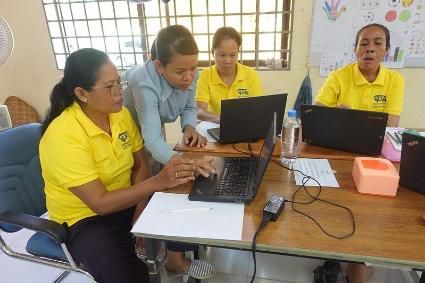
The 7th and final workshop was held in September. 18 participants learned to make two kinds of worksheets and a booklet with their computers and played some resources of the 9th resource package for ‘Which Sport Is It?’

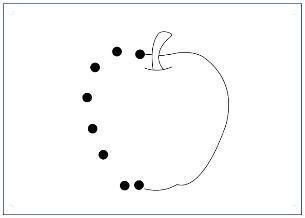
Over the course of three computer lessons this year, the teachers’ computer skills have noticeably improved. According to the post-workshop questionnaire, most answered ‘making worksheets with our computers was easy to understand’, which couldn’t be heard in the past. In fact, 6 out of 13 teachers said they created worksheets by themselves and used them in their classes. Some participants even practiced creating worksheets or asking questions about them during break time. In addition, some teachers created new types of worksheets based on the techniques they learned in the workshop and shared them during follow-up visits.
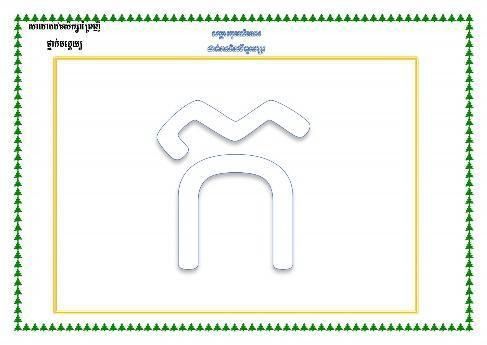
Evidently, the participants’ interest in using computers had also increased. The Ministry of Education Youth and Sports is committed to improving teachers’ computer utilization in their lessons. The participants found the computer sessions useful and expressed interest in additional computer training, including making teaching materials.
During the teaching resource sessions, the participants could try various activities such as storytelling, playing activity games and board games, and singing and dancing to music. The questionnaire revealed that Kamishibai, which are A3-sized storybooks, animations, songs, and worksheets were the most used teaching resources. Evidently, the resources that the teachers tried in the workshops or saw TukTuk staff play in follow-up visits were used more in their lessons, especially the activity games. We couldn’t spare enough time in the previous workshop to play with our resources as the computer training took up a significant part of the day. However, this time we had ample opportunity to showcase all kinds of resources as the computer sessions were shorter than expected. In the next CLIP project, we would like to put as many activity programs as possible to make the computer lessons productive and encourage the target teachers to use our resources and give some feedback to brush up on each created teaching tool.
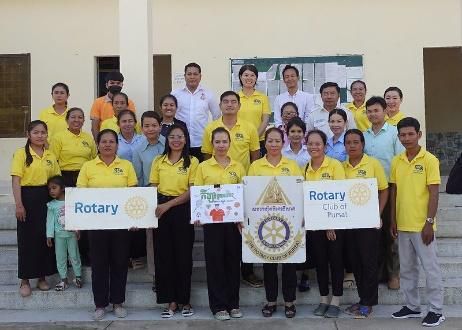
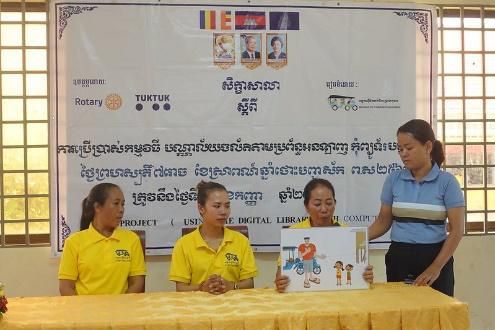
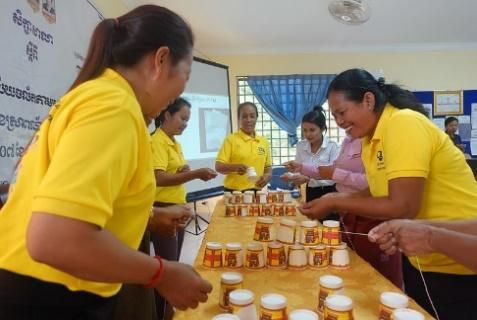
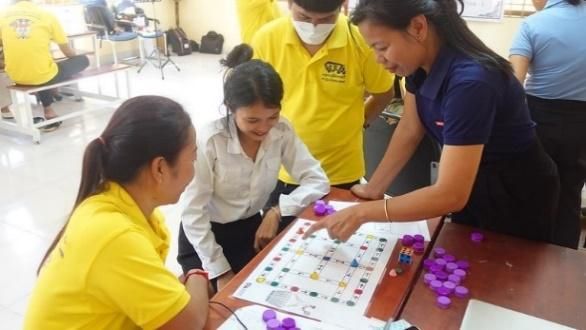
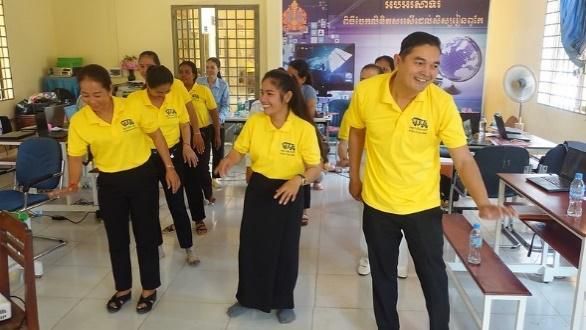
According to the after-workshop questionnaire, all participants were satisfied with the seven workshops as they acquired new teaching techniques like storytelling, songs, activity games, board games, and worksheets. Additionally, they learned how to operate computers, create worksheets, and about classroom decoration standards. They even expressed interest in introducing these workshops to non-target teachers due to their many benefits.
Through these experiences, our confidence has grown, and we have discovered our ability to organize workshops that significantly impact participants. In the next project, the members of Rotary Club of Pursat (RCP) will focus on teaching basic computer operations in the first year. We will be incorporating similar content to this year’s workshops, but our team is eager to introduce even more innovative ideas to enhance the quality of the workshops. We are passionate about developing our skills as workshop providers and teaching material creators and look forward to collaborating with teachers to improve their skills.
Project field visits
During the 7th follow-up visit, we gathered information on the frequent use of computers, tablets, and teaching resources in the Digital Library. Additionally, we conducted an end-line survey to assess how the project impacted the teaching methods of the participants.
According to the follow-up visit, only 5 out of the 13 target classes used tablets while the rest didn’t. This was because they found the computer to be sufficient for showing and searching resources, as well as creating documents.
Due to technical issues with the AccessBox, they were removed from all schools except for one where it still works. All teachers used Wi-Fi by sharing it from their smartphones. Interestingly, even the teachers who used tablets found no significant difference in the use of the computer and tablet, except that the computer was used for creating worksheets and other documents. During the past three months, 7 teachers created worksheets with their computers. The most commonly used software, in order of popularity, was YouTube (including TukTuk’s channel and others), the Digital Library website, LibreOffice, which is a software installed for creating worksheets, and a folder containing teaching resources, which we installed before launching the website. Additionally, the teachers used Telegram and Facebook to access other teaching tools.
Some teachers said they shared the Digital Library website and our YouTube channel with other teachers and parents. One of the teachers who is a leader of the school group, which consists of several neighborhood schools in each region, said she tried to play a game we introduced in the previous workshop with non-target teachers in a technical meeting which is held two times a month to make lesson plans or teaching materials.
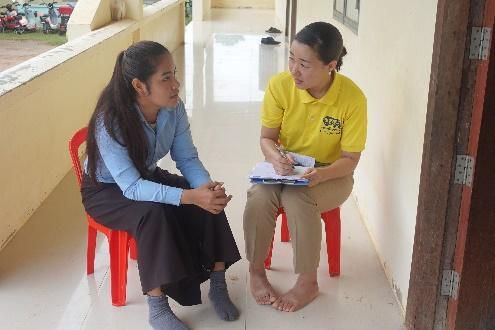
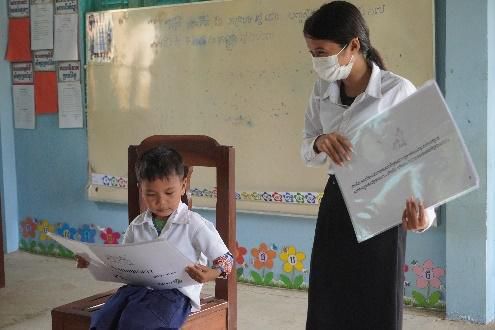
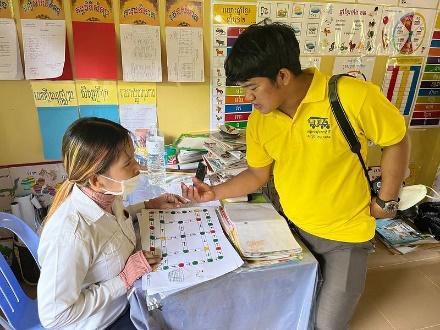
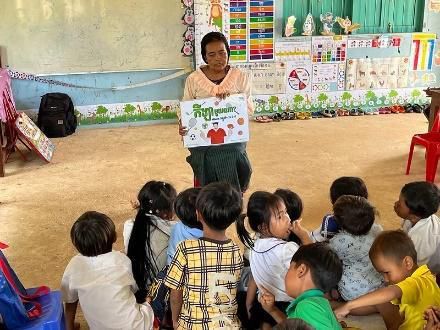
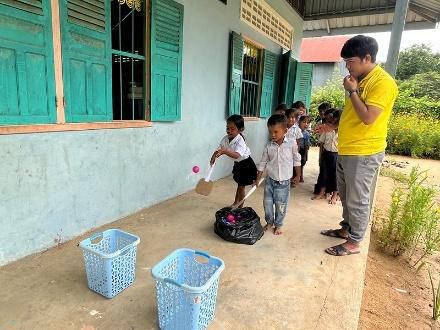
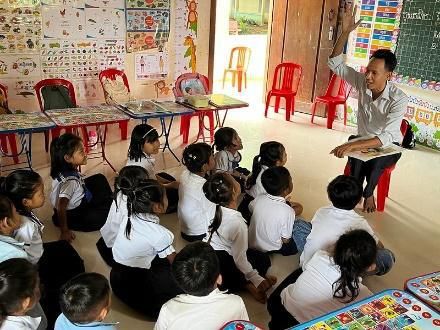
Below is the summary of the results of the end-line survey conducted with 13 project teachers.
Storybook
- All teachers answered that they used storybooks 1-3 times a week. In the previous survey we conducted last December, 3 teachers answered they used storybooks 4-6 times a week, thus the frequency of usage of storybooks was decreased overall. However, 1-3 times is still a good result.
- They received the book from our workshop, the Mobile Library project, in which we lend storybooks to the classes in rotation, and their school’s library.
- The books were lent to students in class and read by the teachers in their lessons.
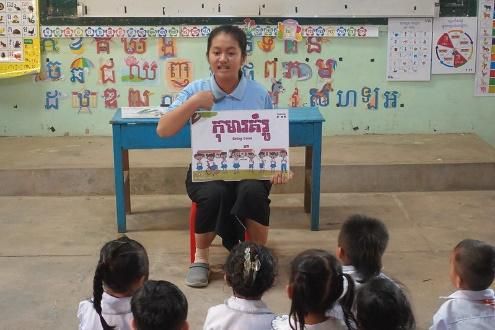
Song
- 9 teachers used songs 4-6 times a week, and the remaining 4 teachers used 1-3 times a week. Previously, teachers who used songs 4-6 times were 6, and 1-3 times were 7 teachers, showing an increase from last year.
- They used both R4C’s original songs and the government songs re-created by R4C. YouTube was used more often than our website to play songs.
- Most teachers used their mobile phones for playing music because it’s easier to connect with their speakers (hence YouTube being more popular), but they used computers or tablets when they showed the dance movements.
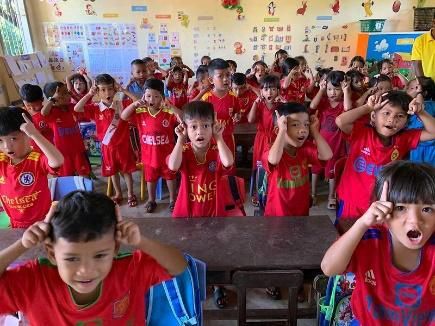
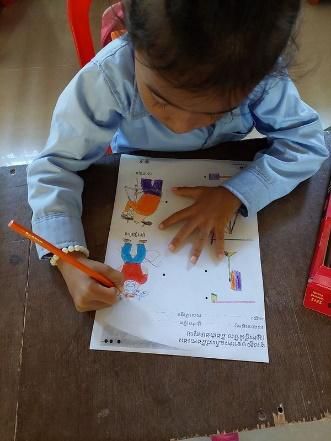
Worksheet
- 9 teachers used the worksheets 4-6 times a week and the remaining 4 were 1-3 times. Last year 10 teachers used the teaching tool 4-6 times a week and 3 1-3 times.
- They got the worksheets from our workshops, the website, and the folder that we installed on their computer or they made by themselves.
- The worksheets were used in science, society, mathematics, and Khmer. Although they could use worksheets for mentality, the teachers preferred to use activities for teaching this subject.
- Most of their school budget was spent on paper for printing worksheets, not only purchasing school supplies. However, most of the teachers of the target community schools and preschools connected to a primary school, receive donations from parents. Two teachers laminated worksheets so that they could use them several times, getting their students to copy to their notebooks directly. This situation has not improved in the two years, since it is also a governmental issue, but some teachers said their principals gave more budget than last year or worked hard to find some spare budget for the preschool class.
Video
- 2 teachers used videos for playing animations and songs 4-6 times a week while 11 teachers used them 1-3 times. Last year the result was 3 teachers, 4-6 times and 10 1-3 times.
- They played the videos from our website and YouTube.
- 11 teachers used the provided computers. The remaining 2 only tablets since they damaged their computers, (1 broken screen and one dropped in water). Teachers generally used their mobile phones as wifi hotspots where internet was not available in the schools
Activity game
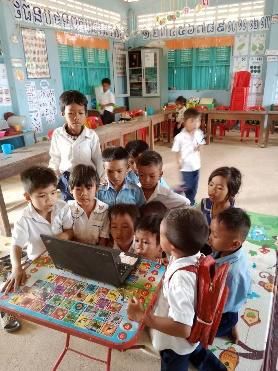
- One teacher did activity games 4-6 times a week, 12 teachers were 1-3 times. Last year there were 3 teachers doing activities 4-6 times per week and 10, 1-3 times. We will ask the teachers as a group in our final CLIP meeting
- Activity game ideas were taken from DOE lesson plans, teachers’ own ideas, R4C workshops, R4C website, YouTube, and Facebook.
- The overall use of activities has decreased, even though there are additional activities provided since last year including printable in-class activities.
Craft
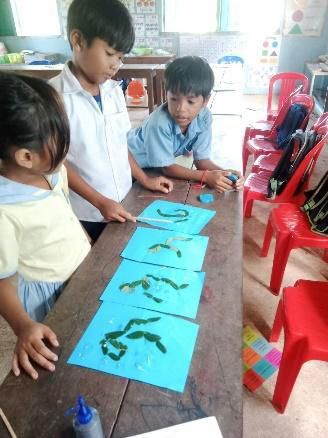
- All teachers did craft 1-3 times a week, the same as the last survey.
- There are many kinds of crafting, but their usage was dependent on the teachers’ interests. Teachers who enjoy crafting tend to offer more varieties of crafts, such as folding paper, sewing, and using beans or straws to create shapes. However, in classes taught by teachers who don’t enjoy crafting, the variety of crafts offered is limited, and students might be given worksheets to cut and paste paper.
Some teachers said they didn’t understand craft ideas so much or had difficulties preparing materials and making a safe environment, especially in classes with many students. We will work to promote the benefits and develop more simple crafts in the future.
Additionally, we interviewed 12 grade one teachers of the target schools. The purpose was to understand the differences between children who attended preschool classes and those who did not. According to the teachers, 68% of the 401 students under their care had attended preschool classes. They also expressed that these students were easier to manage as they were already accustomed to school routines and had a basic understanding of letters and numbers. All teachers unanimously recommended that children enroll in preschool before starting primary school.
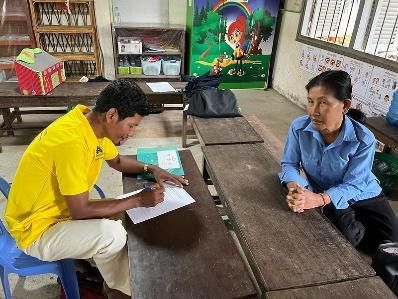
During these interviews, we observed that the teachers underwent not only technical changes but also mental transformations. In the past, the target teachers requested us to continue selecting them as target schools even in the subsequent year after previous follow-up visits. However, this time around, we heard positive voices such as:
- ‘I am fine if the project ends because I can make worksheets by myself now, and I am thinking of binding books that are shared by the Ministry online, similar to Kamishibai that TukTuk provided me’
- ‘I will try to make some crafts that I saw in the workshop by watching videos on the website’
- ‘I will play an activity we played in a workshop when I prepare the materials’; and
- ‘I organized the classroom even more after the school assessment.’
These comments suggest that the workshops had a positive impact and they gained more confidence over the course of CLIP2.
Mr. San, president of RCP, emphasized the importance of cooperating among all project participants, not only the target preschool teachers but also principals, and provincial and district educational officers. Early childhood education is a crucial component of human development, and all project participants should approach their work with pride. In Cambodia, there is a slogan that ‘learning is playing, playing is learning’. Therefore, teachers should enjoy their lessons as well as the students, and focus on creating a fun and interactive learning environment. Speaking of our organization, we have to provide teaching resources that offer a variety of lesson ideas, which should be enjoyable for teachers to use, not just their students. We would like to work toward making all activities in the project more effective for exchanging views on our resources with each other next year.
Other Activities
Resource Package Creation
We finished creating the 9th resource package ‘Which Sport Is It?’ in September and all packages planned to be created in CLIP2 have been completed (the 7th storybook ‘Being Good’ the 8th storybook ‘We Can – Just Differently’ and classroom decorations).
| Category | Resources will be published | Status | Due date | Remarks |
|---|---|---|---|---|
| Book9. ‘Which Sport Is It?’ (New resource package) | ||||
| Completed | ||||
Information Dissemination Via Social Media
We run three open social media (Facebook, Telegram and YouTube) to share teaching resources for preschool teachers and parents.
Those posts include daily activity reports, animations, songs, activities, worksheets, and workshop videos.
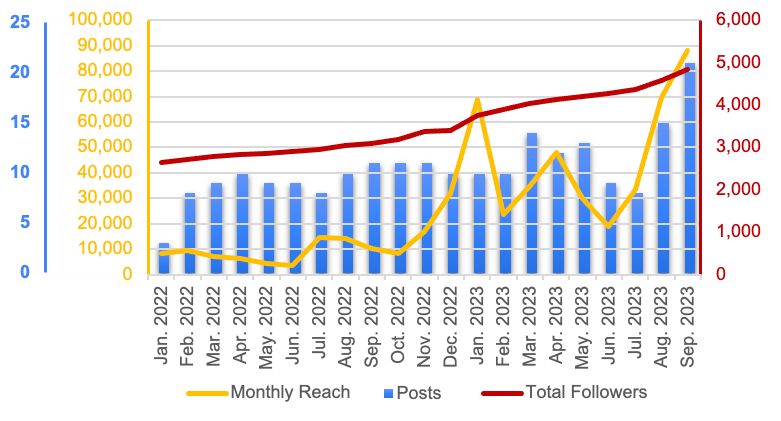
| Quarter | Posts | Reach* | New followers | Total Follows |
|---|---|---|---|---|
| Q1-2023 | 34 | 104,667 | 643 | 4,031 |
| Q2-2023 | 34 | 75,085 | 235 | 4,266 |
| Q3-2023 | 44 | 147,476 | 573 | 4,839 |
*Reach…The number of people who saw any content from the Page or about our Page, including posts, stories, ads, social information from people who interact with our Page and more. Reach is different from impressions, which may include multiple views of the posts by the same people. This metric is estimated.
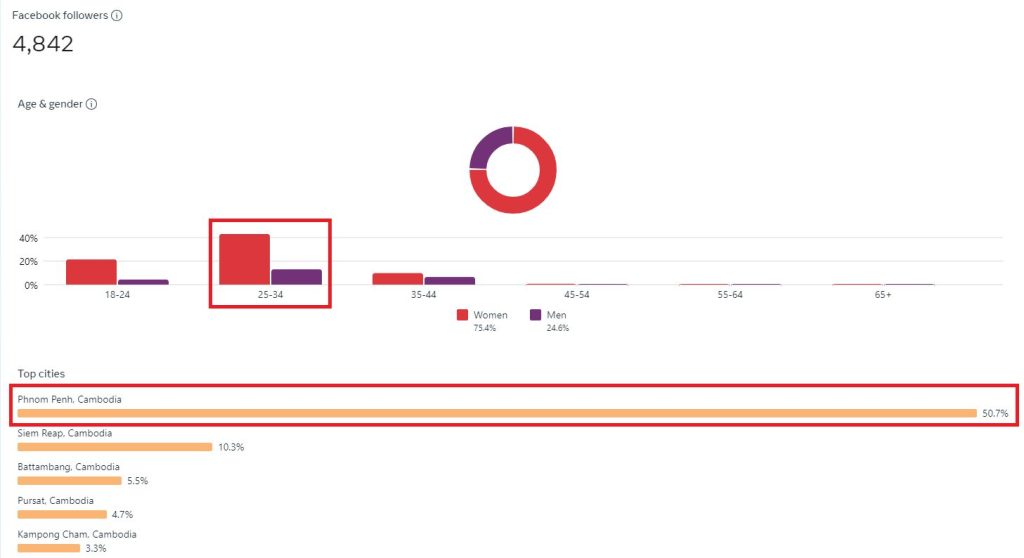
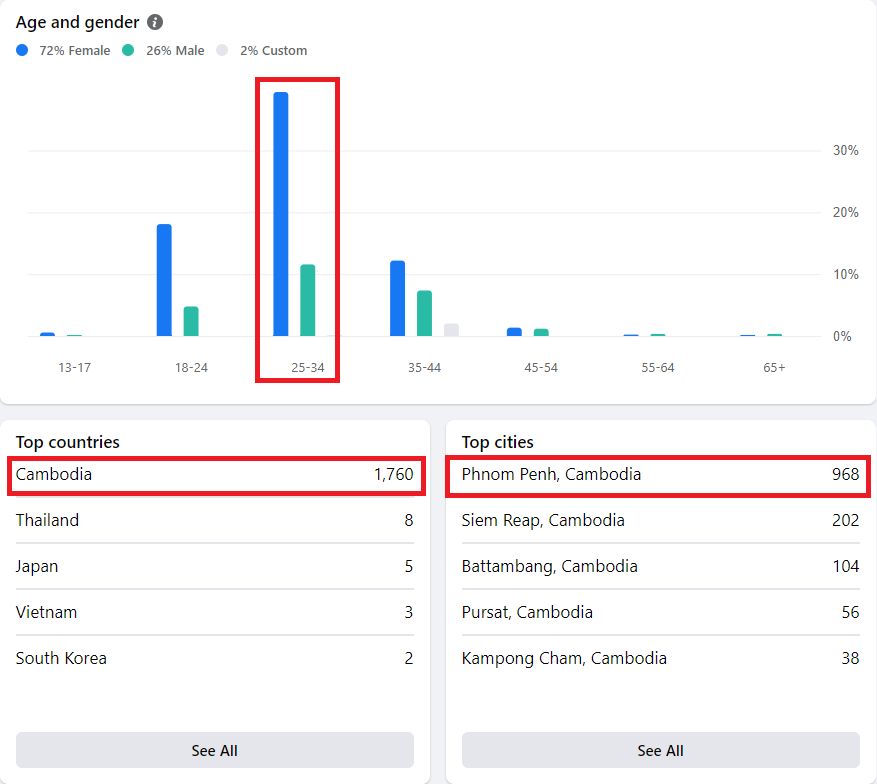
- We tried sharing the posts with other Facebook groups that focus on preschool and primary school teaching materials, and it appears that this has contributed to the significant growth in the number of new followers.
- Followers’ information
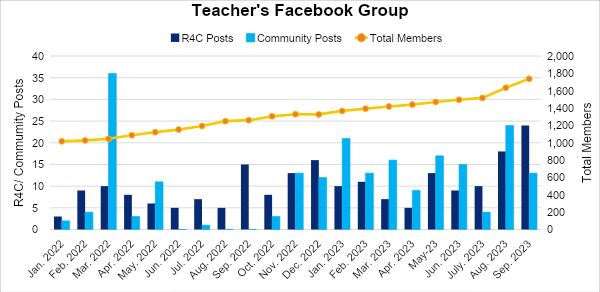
| Quarter | R4C Posts | Community Posts | New Members | Total Members |
|---|---|---|---|---|
| Q1-2023 | 27 | 48 | 90 | 1,417 |
| Q2-2023 | 27 | 41 | 79 | 1,496 |
| Q3-2023 | 52 | 41 | 241 | 1,737 |
- Members’ information
Telegram (messaging app)
The members can see the R4C’s teaching resources, such as storybooks, music, worksheets, etc., in it regularly. And other information related to education for preschool children is posted.
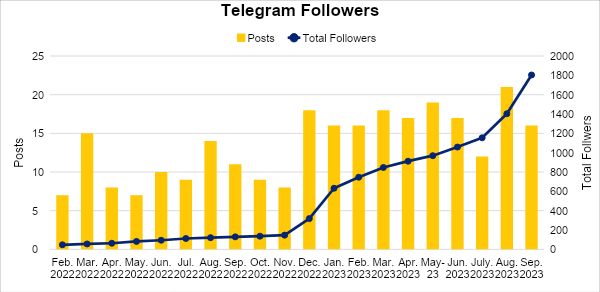
| Quarter | Posts | New Members | Total Members |
|---|---|---|---|
| Q1-2023 | 50 | 529 | 847 |
| Q2-2023 | 53 | 211 | 1,058 |
| Q3-2023 | 49 | 746 | 1,804 |
- It is considered that the significant increase in the number of new members was a result of sharing the group link to other Telegram groups where preschool and primary school teachers from all provinces join and exchange teaching materials.
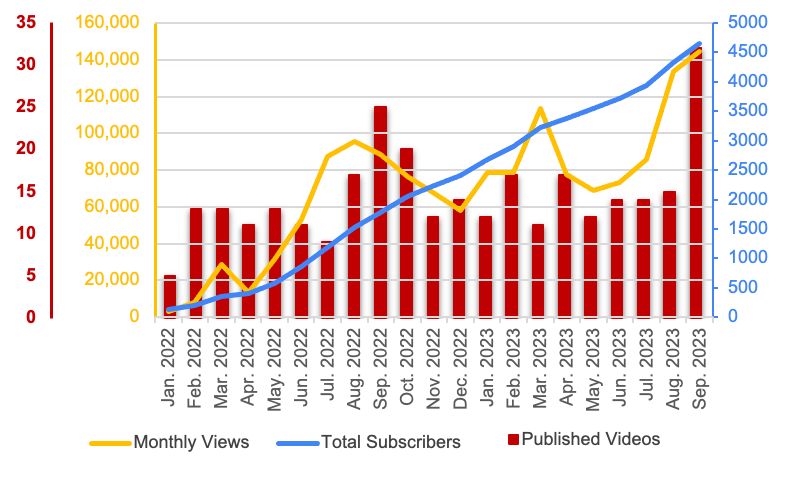
| Quarter | Published Videos | New Subscribers | Total Subscribers | Total Views (all videos) |
|---|---|---|---|---|
| Q1-2023 | 40 | 782 | 3,176 | 255,720 |
| Q2-2023 | 43 | 547 | 3,723 | 221,577 |
| Q3-2023 | 61 | 925 | 4,648 | 364,214 |
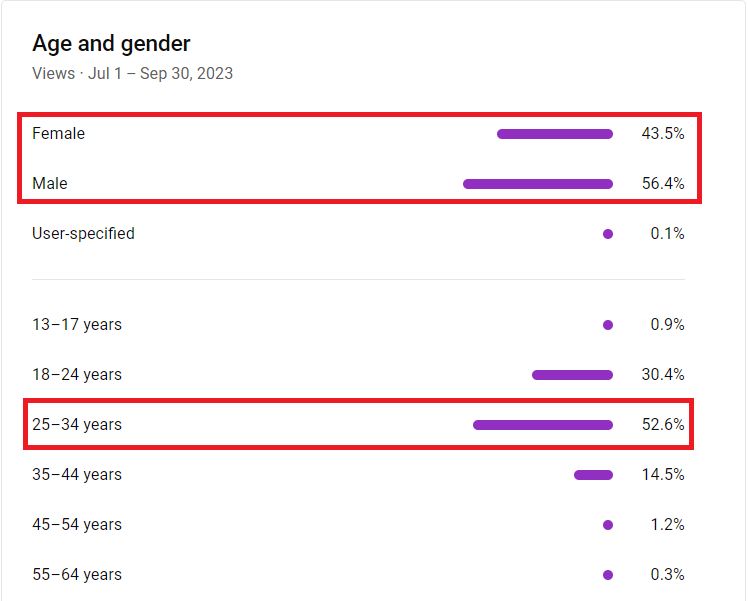
* Note that the YouTube data for gender may be skewed due to sharing phones and not having individual accounts.
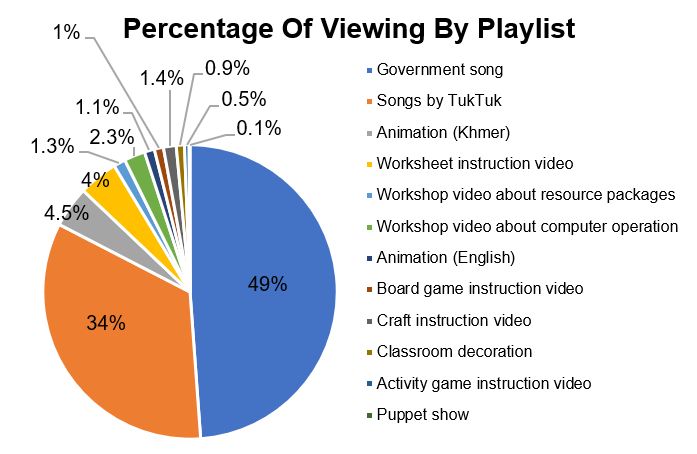
- Most viewed video content was songs and 12 videos that rated 24 % of the top 50 watched videos were videos that TukTuk original songs and an activity game instruction video. Others were songs that the Ministry promoted for the teachers to teach. By playlist, the chart is shown below.
- Followers’ information
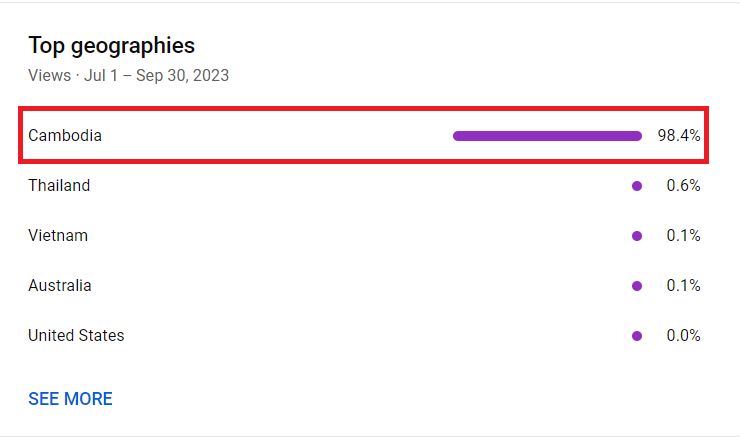
- By region, watched in Phnom Penh was about 72% of overall, and the next was Siem Reap (1.6%), Battambang (0.2%), Preah Sihanouk, Kampot, Poi Pet, Takeo, and Kampong Speu.
Free Educational Material Distribution Website
We launched this website in August 2022. The viewers can download those teaching tools for free and without royalty. This website access record shows access of people who visit the page from their device and it includes non-target teachers and parents but also foreigners.
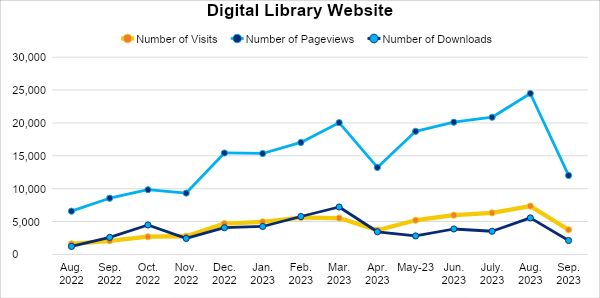
| Quarter | Number of Visits | Number of Pageviews | Number of Downloads |
|---|---|---|---|
| Q1-2023 | 15,430 | 49,828 | 16,962 |
| Q2-2023 | 14,868 | 52,182 | 10,188 |
| Q3-2023 | 17,425 | 57,351 | 11,189 |
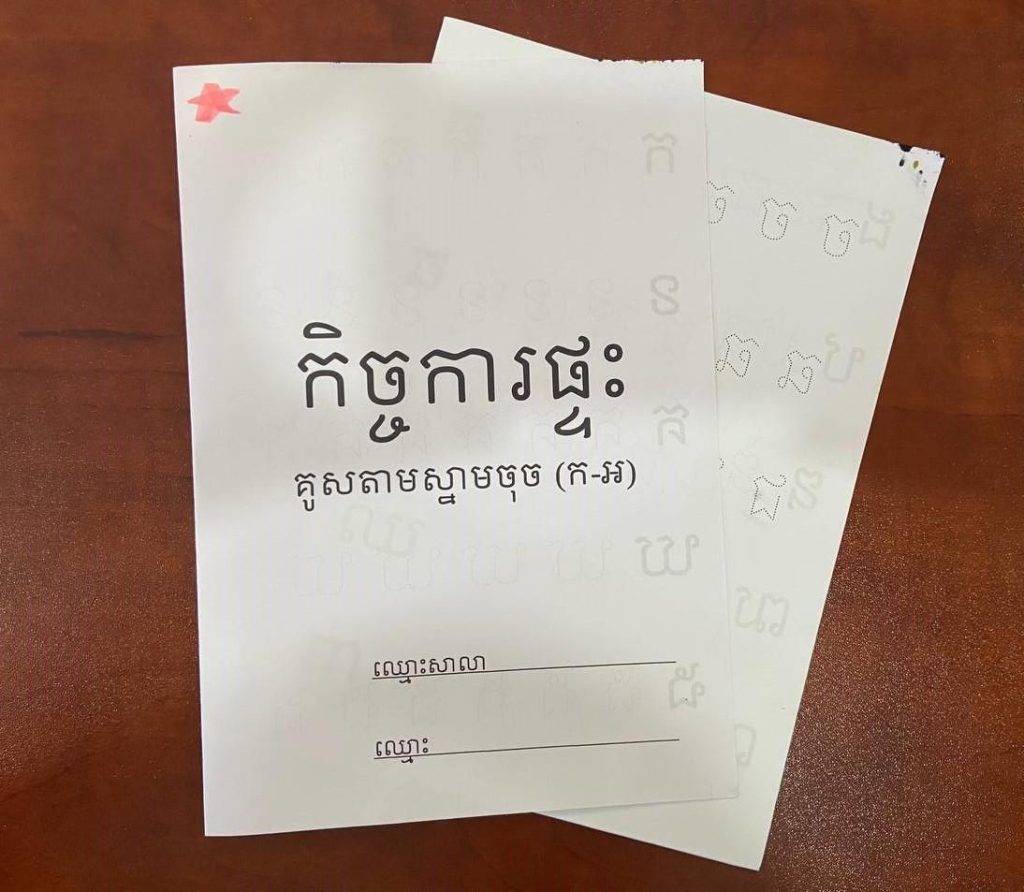
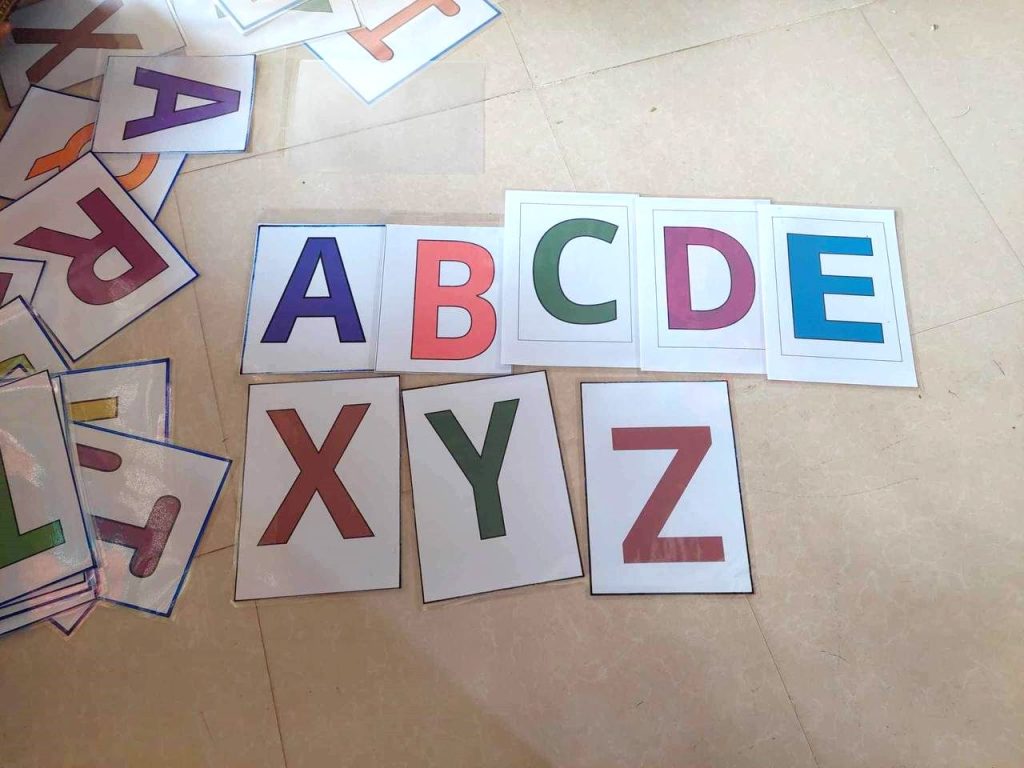
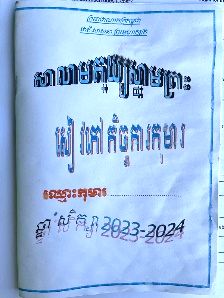
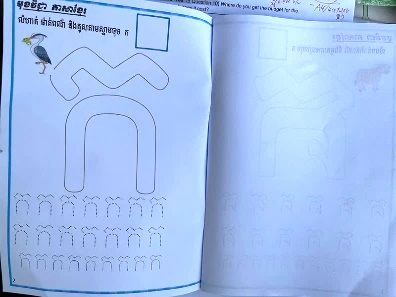
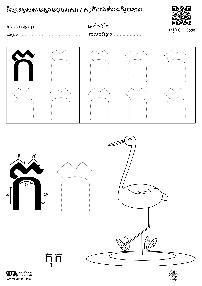
Most viewed contents were classroom decorations, worksheets and images. Besides, the most downloaded resources were Khmer alphabet worksheets made by TukTuk (photo on the left side) and one of the Khmer alphabet worksheets made by a DOE staff member (photo on the right side).

Speaking of the viewers, 91% accessed from Cambodia and 71% were from Phnom Penh, and then, next was Kampong Speu (3.3%), Kampot (1.3%), Battambang, Kampong Cham, Kampong Chhnang, and Kandal. 57% of all users visited the website with their smartphones and 41% with computers. Then, 87% of visitors came from the Facebook page, 11% from Telegram, 1% from the YouTube channel and 1% from Instagram.
Measuring Success
| Project | Collection method | Frequency | Beneficiaries |
|---|---|---|---|
| Number of beneficiaries of the project | |||
| Number of benefiting school-age children | Public records | Every three month | 518 |
| Number of teachers who took workshops | |||
| The 7th workshop | Direct observation | Once conducted | 20 |
| Number of teachers who took regular interviews | |||
| The 7th follow-up visit | Focus groups/interviews | Once conducted | 13 |
| Information dissemination via social media | |||
| Number of people who reached the posts | Focus groups/interviews | Every month | 147,476 |
| Number of people who join the ‘Telegram’ group | Focus groups/interviews | Every month | 1,804 |
| Number of people who viewed the YouTube videos | Focus groups/interviews | Every month | 364,214 |
| Number of people who visited the Digital Library website | Focus groups/interviews | Every month | 17,425 |
Next Schedule (October – December 2023)
- Conduct the project closing meeting (Nov. 21)
Help us keep TukTuk rolling
Your gift pays for workshops, books and the free Rermork Digital Library.